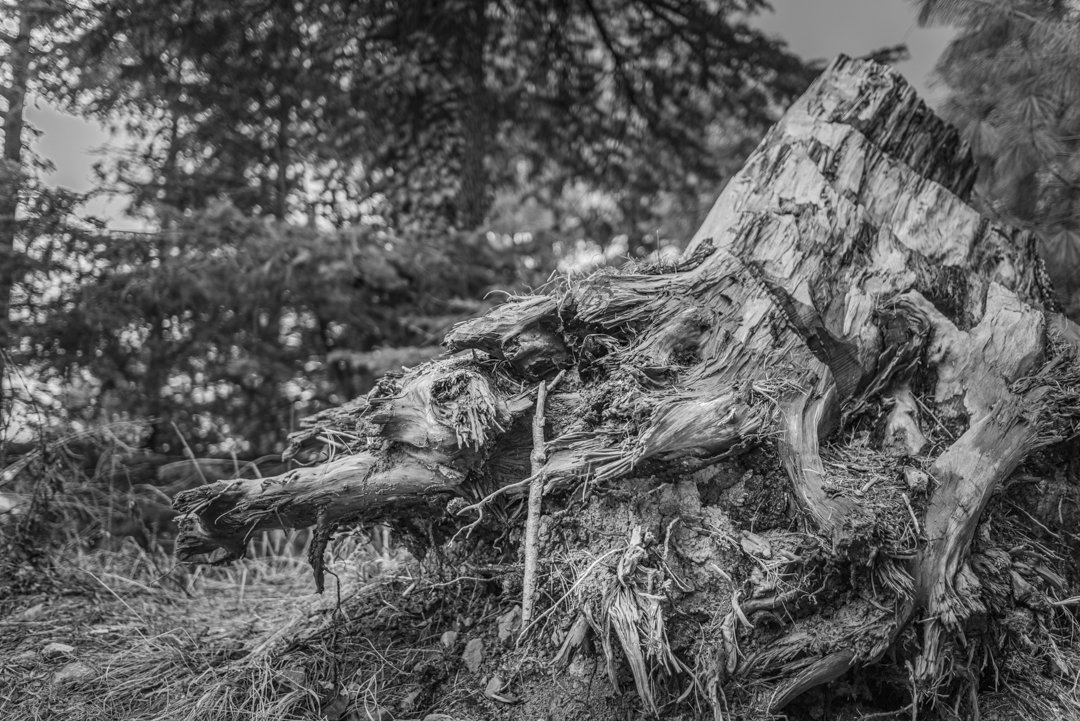
It was the spring of 2018, around 3 pm if I remember right. The day was cloudy, with sharp rays of sun shining through pockets of open sky. Near the top of the mountain, about 9,020 feet (2,750 metres) above sea level, the air is cleaner and everything has a brightness that lights up certain objects, like this dead tree stump. Compared to an urban landscape, the light on a high mountain is much better, and much more ideal for photography.
The light was drawing out detail in every inch of the forest. I had almost reached the top of Thandiani when, on one sharp turn, I saw this tree stump, pulled out by an excavator, its roots laid on one side of the road. From a photographic point of view, the roots had gorgeous detail: innumerable thread-like filaments spreading out with a unique wooden texture. A magnificent structural pattern, and it caught my eye.
In a broader sense, each and every life has its roots in time and space. These roots tell a story too, the story of a tree that may have lived for over a century, and they can be related to our own lives. We all have forgotten roots buried deep in history and time. If we stay connected to our roots, we live like a living tree. As Francis Bacon wrote, "Histories make men wise; poets witty; the mathematics subtle; natural philosophy deep; moral grave; logic and rhetoric able to contend." But if the roots are pulled out, the very life ends.
Observing these roots, I felt a deep connection, hidden in the depth of my thought. They had been buried deep in the earth, and when they were pulled out, they were exposed to conditions that were never meant for them. Those conditions made them dead, and now the story is all they have left.
A high-resolution fine art landscape photograph, part of a strictly limited digital edition of just 25 numbered copies. Instant download after purchase.